
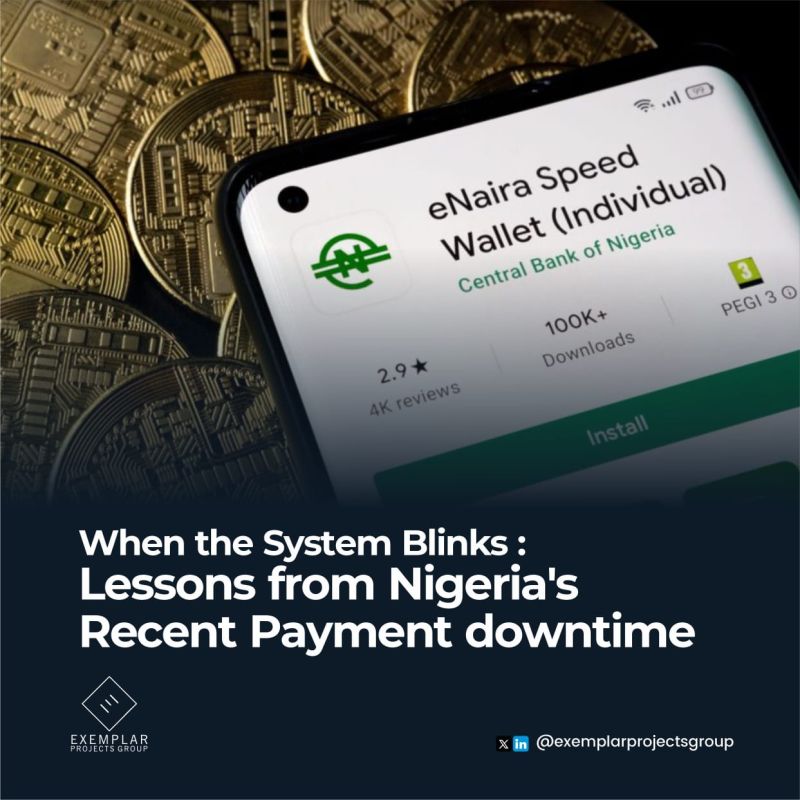
Why Payment Downtime Costs More Than Money in Nigeria
10 July 2026
It usually begins in the middle of something ordinary. A vendor waiting to confirm a payment. A customer standing at a counter, phone raised, watching a POS machine freeze at the exact moment it should approve a transaction. Nothing dramatic happens. Only a pause that slowly turns into uncertainty.
That pause has become increasingly familiar in Nigeria's digital payment space, where mobile transfers and fintech apps now power everyday commerce. Users continue to report intermittent delays across banks, fintech platforms, and payment terminals, disrupting transactions expected to happen instantly.
A study by the Bank for International Settlements (BIS) on payment system resilience notes that even brief disruptions in digital financial systems can significantly weaken user confidence, particularly in economies where digital payments are rapidly replacing cash. The study highlights an important point: trust is shaped less by perfect performance than by how systems respond when they fail.
That becomes clear in everyday situations. A food vendor in Osun recently described how a customer's transfer showed "successful" but did not reflect until much later, forcing her to suspend sales to avoid confusion. In another widely shared experience, a commuter attempting to pay by transfer had to retry several times before the payment finally went through, increasing frustration for everyone involved.
These experiences reflect a broader reality. Nigeria's digital payment growth has been driven by fintech innovation, mobile penetration, and the shift toward a cashless economy. Yet the infrastructure still depends on interconnected systems working together. When even one layer slows down, users don't see the technical failure — they simply experience interruption.
A McKinsey Global Payments Report (2024) notes that customer trust in digital payment systems is highly sensitive to inconsistency, observing that even infrequent transaction failures can have an outsized impact on long-term loyalty. Users may forgive complexity, but they struggle with uncertainty.
This is why payment downtime is not only a technical issue — it is also a behavioral one.
Payment providers should also expand multi-route transaction processing so payments can automatically reroute when one switch is congested. Just as important is proactive communication. Informing users when systems are unstable reduces confusion, repeated transactions, and frustration.
Finally, institutions must invest not only in speed but also in perceived reliability because, in digital finance, confidence is as important as execution. A blinking system is not necessarily a broken one. But in a cashless economy, even brief moments of silence carry weight. Every delay becomes a question, and every question tests trust.
More articles



SWAVE Money
Ready to bank smarter?
Zero-data banking, instant transfers, and real rewards. Download SWAVE Money today.