
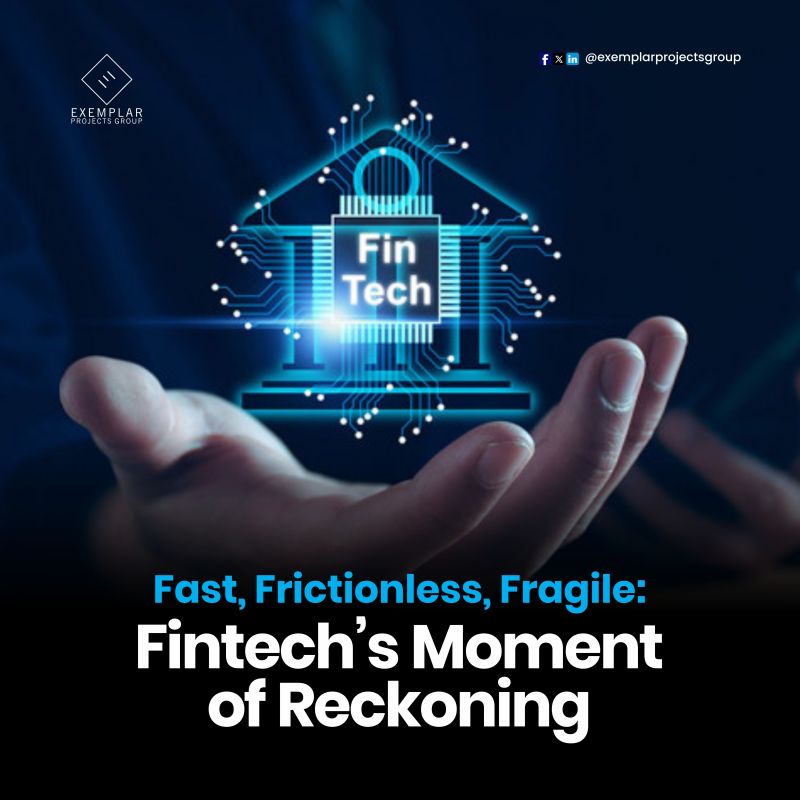
Security as a Feature: Why the Next Fintech Edge Is Trust, Not Speed
17 April 2026
There was a time when opening a digital bank account felt almost effortless — just a few taps, a phone number, and instant access to financial services. It was this simplicity that powered fintech's rapid adoption across the world. But today, that same simplicity is being questioned.
Recent regulatory shifts, including stricter digital verification frameworks in countries like Uzbekistan, signal a quiet but decisive turn in the industry. Identity is no longer something you claim — it is something you must prove, repeatedly and convincingly. Multi-factor authentication, biometric checks, and tighter data alignment are no longer optional layers; they are becoming the new baseline.
At its core, this is a response to a growing imbalance. The same infrastructure that made financial services widely accessible has also lowered the barrier for fraud. Synthetic identities, automated account takeovers, and increasingly intelligent cyber threats have exposed a difficult truth — speed without structure creates opportunity, not just for users, but for exploitation.
This shift aligns with the principles of Behavioral Economics, particularly the idea that friction, when applied intentionally, can improve outcomes. A study by researchers at Harvard Business School highlights that well-designed "positive friction" can reduce risky behavior and enhance decision quality, especially in digital environments where actions are often too fast and automatic. In fintech, this translates into systems that slow users down just enough to verify identity and prevent costly errors or breaches.
Fintech companies are being forced into a more complex role — one that goes beyond building seamless experiences to engineering resilient systems. The challenge is subtle but critical: how do you introduce necessary friction without eroding user trust? Because while security demands more steps, user behavior still leans toward simplicity.
This is where design becomes strategy. The next generation of platforms will not win by being the fastest, but by making security feel intuitive — embedded so deeply into the experience that it protects without overwhelming. In this sense, friction is no longer a flaw; it is becoming a feature.
For users, this shift may feel inconvenient at first, but it reflects a deeper evolution. Trust in digital finance is no longer assumed on the basis of convenience — it is being constructed through verification, layer by layer. Each additional check is not just a barrier, but a signal that the system is learning to defend itself.
Fintech, in many ways, is growing out of its adolescence. It is moving from rapid expansion to responsible scale, where reliability matters as much as reach.
Because in a system where money moves in seconds, trust cannot be optional.
More articles
 Fintech
22 Apr 2026
Embedded Finance: When Banking Becomes Invisible Infrastructure
 Business Strategy
21 Aug 2026
Convenience Is the New Currency
 Finance
8 Mar 2026
The Democratization of Investment: Access, Risk, and the New Wealth Divide
SWAVE Money
Ready to bank smarter?
Zero-data banking, instant transfers, and real rewards. Download SWAVE Money today.